martes, 14 de febrero de 2012

Aldershot Girls: are London Olympics coming Too Soon?

      
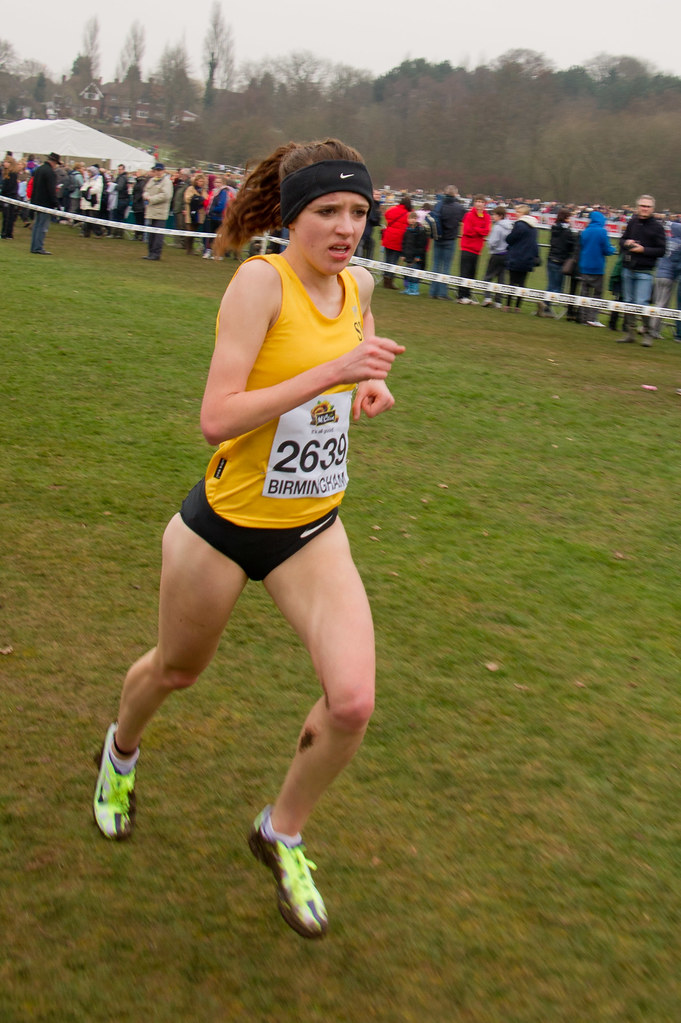
Esther Chemutai and Charlotte Purdue running in foggy Antrim in 2011
Photo: Mark Shearman
http://www.iaaf.org/CROS11/news/newsid=59111.html
               Both Sebastian Coe and Steve Cram have complained lately British milers do not enjoy anymore competing through cross country trails during the winter season. In the 80s every distance runner used to do it, apart from the popularity of the speciality back then, as a basic preparation to gain in endurance and strength for his summer track campaign. For both legends of track and field this current lack of interest in cross country inside the UK is one of the secrets of the long crisis the nation is living in middle distance running. No current British athlete can be compared to Coe, Cram and Ovett; not even to Elliott, McKean or Williamson. Baddeley has fallen short of the expectations, Michael Rimmer is not consistent enough and Osagie is still on the making. Yet nowadays there are different times and even the World Cross Country championships are not going to be held this year for the first time since World War II. There is still the consolation of Mo Farah, who, by the way, was born in Somalia and whose amazing breakthrough came as he left the UK to join Alberto Salazar’s stable in Oregon. Still a British world champion at the 5000m, in a moment 80% of the kids of the country who are involved in track and field when they are 12 years old have given up the sport when they reach their twenties. Why keep it up if there is not a chance of getting close to the East Africans? Is it not the argument used by high school wonder in the USA Lukas Verzbikas when he decided to switch to triathlon? In Great Britain there is also now a never seen before passion for cycling, which has brought to the victory of Cavendish at the world championship.  
            But this is a man’s world. We have not thought about British female yet. And if there is no worthy heir in the country of past running legends among the men field, we can not say the same about the women’s. Not going very far away in time Jennifer Meadows won a bronze medal at the 800m at Berlin World Championships and Hannah England struck silver at the 1500m in Daegu. However role models are closer in time: Dame Kelly Holmes obtained her sensational double only two Olympic Games ago and Paula Radcliffe, whose world record in the marathon stands out of reach even for Kenyan and Ethiopian athletes, is still training hard to win at last a well-deserved Olympic medal, along with the younger generation. And, apart from some track and field drug addicts, has anybody really realised about the outstanding performances British teen girls are accomplishing in the last couple of seasons in Cross Country? Do not fear these youngsters the hardness of this kind of competition and the terrific East Africans? Listen to the words of the veteran of the group, three time European junior cross champion Stephanie Twell:  “Cross Country gives me strength of character because it is tough when you are racing in the mud, in the hills and in horrible weather. I think it gives you a sense of what being a real runner is all about; you are outdoors and you are facing adversities, both physical and mental. Plus the over-distance training you need for cross-country complements track events.” (1) It looks like these kids are really old-school in their approaching to athletics. And this revalorisation of Cross Country is common among her mates, even the youngest ones as Emelia Gorecka: “The course at Stanmer Park in Brighton was incredible! I can only describe it as a true cross country course – it had hills, mud, woodland, small paths and huge fields… a really enjoyable course to run on.” (2)    

Emelia Gorecka, the European junior champion
http://www.flickr.com/photos/adamkr/5501761119/sizes/l/in/photostream/

               Great Britain won all three female team titles at last European Cross country championship in Velenje and two of the individual races, thanks to Emma Pallant in under-23 category and Gorecka in juniors. It was just the continuation of a streak which started with the upset of a 16-year-old Steph Twell in 2006. Thanks to the Colchester girl, Charlotte Purdue and Emelia Gorecka, the Brits have grabbed five out of the last six junior titles, including a stunning sweep of the first six places in the 2008 edition, when Steph completed her hat trick. (3) Some of the United Kingdom Cross Country standouts are older as Hattie Dean, Freya Murray and Gemma Steel, who has been the senior leading Brit this winter, third in Velenje and second in Edinburgh and Antrim, only inferior among Europeans to the amazing Irish Fionnuala Britton, winner in all those three races. Nevertheless the most interesting athletes of the country are quite young and precocious runners: Twell won gold at the championships at 16; Purdue snatched bronze at 16, silver at 17 and eventually gold at 19; Gorecka, who had won 15 consecutive cross country races in 2008, obtained bronze two years afterwards at the European Champs, being 16 years old and gold at 17. Only Emma Pallant seems to be performing right within the parameters of her age.  Besides, Purdue became the youngest winner of the senior national trials in 20 years, and went on to cross the line at Punta Umbría World championship as the first European in place 14th. On the other hand, Gorecka, was the youngest contender at the junior race at the precedent edition in Bydgoszcz, finishing a creditable 23rd, which she improved to 15th in Punta Umbría. Twell, Purdue, Pallant and Gorecka belong all four of them to the same athletic club, Aldershot Farnham and District AC and train together under the supervision of acclaimed coach Mick Woods.
            Woods, a 63-year-old former marathoner from Ireland, has also an outstanding résumé. The mentor of the new generation of British female athletes has been coaching since 1986. Until 1993 he was also working as a full-time telecom engineer but decided to concentrate in his track and field profession once she got a job at St. Mary’s High Performance Centre at Twickenham University College, the main base of Aldershot club and the place where Charlotte is studying History. Mick Woods has coached at least one athlete in every World Championship since 1996. At the last one in Punta Umbría, 8 representatives out of 24 belonged to Aldershot. (4) Furthermore, three of his charges won in consecutive editions the British Rising Athlete of the Year award: Stephanie Twell in 2008, Charlotte Purdue in 2009 and Emelia Gorecka in 2010. Sprinter Jodie Williams eventually broke the streak in 2011, when no wonder Mick Woods was named Mentor of the year by the same prestigious magazine, Runner’s World. (5) 

Mick Woods and outstanding pupil Stephanie Twell
http://www.athleticsweekly.com/coaching/aldershots-waterloo/ 
             And what is the secret behind that stunning success of those young girls, of that single coach? Some has compared this athletic club with the one Kiyoshi Nakamura, the coach of Toshihiko Seko and Douglas Wakihurii, used to have. (6) It is a question of total loyalty, blind trust in Woods’ methods. Charlotte Purdue arrived to the club being 11, when she was spotted by Woods in a school race and Emma Pallant has been there as long as her mate. Steph Twell joined Aldershot even younger, when she was 9. The simple reason was she was living 600 metres from the track and her father was involved in the club. However nowadays she would never quit her coach. The prove is she was adamant in her decision of sticking with him in a moment it seemed St. Mary’s was going to be excluded from the high performance centres chosen to prepare British endurance athletes for London Olympics and she was asked to relocate to Loughborough with another coach. (7) Purdue and Pallant share her mate’s faith towards their lifelong trainer. Other athletes as Emelia Gorecka and Georgia Peel came later in their careers from other clubs but they are as enthusiastic about Aldershot. Gorecka states running is her relaxation time from studies, thanks to the extraordinary atmosphere created in training by her fellow athletes and Woods, which help her to stay at any time calmed and focused . Her Aldershot mates are also her best friends out of the track. (8) 
              Aldershot will never be a running elite-building factory. Mick Woods’s personality will never be up for that. For the successful coach the more pupils the better, especially when the sport drop rate is so high. And he does not necessarily recruit the most talented youngster. Purdue finished 16th at the race she was spotted by Mick, just at time because she did not expect to keep further her running career. "She was not an athlete with perfect movement. She had little leg lift and was very much a heel striker, but what I saw was someone who could have an engine - endurance - and that has always been Charlotte's success.” (5) What Woods praises in a trainee is commitment and perseverance, the willpower to keep going even in adverse circumstances, when results are not coming or injuries weaken confidence. In his privileged bunch there is no room for egos either. He places team over individual results, in a modus operandi similar to a pyramid, in which role models as Twell, Purdue (the top), inspire those around them (the base), creating the ethos inside the group. Then the target is to channel the base towards the top. (5) These amazing girls have also been a souce of inspiration for their male counterparts, who have raise their standards, as Jonathan Hay, stunning runner-up in the race of the Olympic champions last month in Edinburgh. Besides, working together, athletes with different skills or capacities support each other, as for example Emelia Gorecka contributes to Georgia Peel’s endurance improvement, benefiting at the same time from the superior speed of her mate. It helps engender the commitment and work ethic; this builds on the club’s success and, in turn, the athletes’ individual goals and performances.  

Georgia Peel, the trackster of the group... or maybe...?
http://www.prlog.org 

           There is always room for making friends and laughs but work have to be done. And it is quite tough. Mick Woods is someone who believes high volume is the base for subsequent quality work, as Lydiard or the same Nakamura. It is something many of the current coaches, who prefer shorter staff, have neglected, according to Woods’ opinion. And yes! Cross country in the winter is the best way to start the year. Even teen Georgia Peel whose longest event during the track season will be the 1500m, log the miles and competes happily through the mud, forest hills and the snow to acquire endurance and toughness for her summer races. And eventually, intensity is also required in training. If you want to be fast in championships you first need to be fast during your workouts. 
             In the last two winters some of the Aldershot standouts have also had the opportunity of training in altitude in Iten, Kenya, enjoying the facilities of Lornah Kiplagat’s training centre. One year ago, Twell and Pallant made the trip, along with other British athletes, and recently Steph repeated the experience with Charlie. Mick Woods could stay with them most of the time, getting fit following them riding a bike. (9) For natural runners like them it was an ambivalent journey. Emma was elated of her stage in Kenya and came back with positive feelings about everything from the food to the landscape. (10) Purdue was not as relaxed in Iten. She praised the work of the Kenyan staff at Lornah’s but the shower was “shit” and the gym was too crowded and noisy. Specially she did not get to adapt to the muddy and rocky trails and had to return home with a hurting knee. (11) Both expeditions were unlucky with climatic conditions. The first time it was too dry and too much dust was in the air. The second time the weather was unexpectedly rainy and it made difficult running. Anyway, injuries had been an obstacle too much frequently in the way of Mick Woods’ disciples, often as consequence of the highly demanding Aldershot’s workouts. Pallant faced retirement after a knee operation in 2009 and ongoing struggles in following seasons. Purdue did not race in six months in 2011 because of a stress fracture of the knee. Finally, Twell broke her ankle in five pieces in a Cross in Brussels one year ago and has been back only recently. The courageous athlete was prevented against running cross country again but she took the risk and achieved a praiseworthy fourth place in Velenje.          

             Fortunately all these amazing runners have currently left all their injuries behind and are training at full power for London Olympic Games. Yet it had been nice if their beloved specialty, Cross Country, would have been included in the Olympic programme. Lacking it, they will have to concentrate their efforts for the track. To date, the only Aldershot athlete whose performances on the stadium match the ones on the fields is Steph Twell, who won the final at the World Junior championships in 2008, in a race Emma Pallant struck bronze. (12) That victory over Kenyans and Ethiopians, notably over Kalkidan Gezahegne, current world indoor champion and 4th placer outdoors in Daegu, was a huge boost of confidence for Steph, who also made her Olympic debut in Beijing that same year. Afterwards she has improved her marks to 4:02.54 at the 1500m and 14:54.08 at the 5000m, alternating up and downs in major championships. In her reappearance year after a whole season cut down by her broken ankle, she is entering the turning point of her career. Almost 23 by the Games, she will have to prove herself she can now face anybody. It will be an excellent opportunity for her in an event quite open and besides cheered by her own public. Look at also for Emma Pallant, for years at the shadow of giants Twell and Purdue, who eventually won her first international title in Velenje and can be in the year of her breakthrough.
            Charlotte Purdue proved she was born for tough cross country challenges, ever since she sensationally endured extreme heat and humidity in Mombasa in 2007, to end up the first not-African in the junior contest at age 15.  Lately we have seen her also successfully mastering the roads, as at last Bupa Edinburgh Great Run, where only one of the best, Lucy Wangui, could beat her. Charlie has entered next New York City half-marathon and her future may well be at the longest of the Olympic events. Twell is on the way of becoming the new Kelly Holmes, while Purdue might be a worthy heir of Paula Radcliffe… but for Rio de Janeiro in four years time. Meanwhile, she would try to qualify for the 10.000m for London, but her far-from-economic style of running does not seem to fit the track. For another pure cross country runner, Emelia Gorecka, these Games come too soon but if Jordan Hasay has focused all her season for the Olympic US trials, why should not try such extraordinary youngster as Emelia. Her teen companion Georgia Peel, who like Pallant (13) attended the “On Camp with Kelly” mentoring project for promising middle distance runners, would like to give joy to Dame Holmes qualifying for the host Games at the 1500m. (14) Winner at her first international outing, the World School Games in Doha in 2009, where we also discovered Gorecka, Georgia suffered later two successive setbacks at the Youth Olympic Games and Youth World championships, returning home without a medal. (15) Now she will be up for revenge. Too much too soon, but when there is so much talent and athletic passion you never know.         
Emma Pallant at her training stage in altitude in Iten, Kenya, in February 2011
http://www.athleticsweekly.com/blog/starting-2011-up-high/


martes, 10 de mayo de 2011

John Ngugi and his time

John Ngugi, in action during the last of his 5th World Cross Country 
victories, in  Boston, in the year 1992.
Getty Images   www.iaaf.org 
          African nations are understandanbly upset these days. One of the oldest events in sport, the World Cross Country Championships, which has been held every year since its creation in 1903, with the only break of the world wars, has suddenly become a biannual event.  They say westerners are ashamed of the absolute stranglehold in the discipline by black athletes and this is the main reason for that decision. And they are not totally wrong.  After 31 consecutive team victories by Kenya and Ethiopia in the men's contest, 24 of them by the former nation, with an astonishing 18 winning streak, without any precedent in any sport, European countries have started deserting the event.  Some runners do not have any more interest in crossing the line as the first non-African-born in place 23rd, the old continent audience statistics have also dropped dramatically, because of its representatives failure to face Kenyans and Ethiopians, and sponsorship is being increasingly harder to get. As incredible as it might sound, last world championship was not broadcasted in Spain by any TV channel, despite being the host country.      
     It is hard to believe now, Cross Country, once in the Olympic Games schedule, used to be immensely popular all over the world.  It started as a British nations contest but gradually more European countries, the United States, Australia… were invited.   World Cross Champs were the only athletics event where every elite runner from the 1500 to the marathon was present, so the race was a truly challenging one, and a gold medal in it was one of the most prestigious rewards an athlete could get in his sportive life.  Ehiopia and Kenya only entered the event in 1981, but they did in style since the very beginning. 

        Great expectations were created in the Madrid’s “Hipódromo de la Zarzuela” venue, because of that debut, especially around the Ethiopian team performance. The East African powerhouse had been back to the Olympic Games, in Moscow, just the year before, and the 10.000 metres riveting match against Finnish athletes, was still fresh.  Among the members of that memorable 1-3-4, Miruts Yifter and Mohamed Kedir were present and so was steeplechase bronze medallist Eshetu Tura.
Their performance in Madrid was going even better than expected: Six Ethiopians were well ahead of the rest of the field with one lap to go, but inexplicably they stopped, as the bell started ringing, thinking they had already finished.  In the middle of the chaos, they resumed running and still managed a first team victory, while Kedir had the guts to challenge until the end American Craig Virgin, who could defend successfully his title.  Yet, the runner-up must have been raging all the year because of that unfortunate race, and did not give Alberto Salazar in Rome-82 any option to follow on his compatriot steps.  A 20-year-old youngster called Bekele Debele obtained a second victory for Ethiopia on Gateshead mud, while Some Muge grabbed the bronze for the first Kenyan individual medal ever.  Between them, Carlos Lopes won the silver. The Portuguese veteran was in his best form ever and no runner could match him, neither in the two following editions of the World Cross Champs, nor in the 1984 Olympic Marathon, which he won at age 37.  Ethiopia had the small consolation of the 4th and 5th team victories.  No one could imagine at that moment Carlos Lopes was going to be the last man born outside of African shores in winning the World Cross Country championships.  26 years have passed since and counting.       

Bekele Debele edges Some Muge, Carlos Lopes (hidden), Antonio Prieto, Alberto Salazar and Robert de Castella
at 1983 World Cross Country Championships, held in Gateshead
http://www.elatleta.com /  http://ourathletes.blogspot.com/
     
The 1986 edition was to be held in Neuchatel, Switzerland, without the titleholder, Carlos Lopes.  It had been raining copiously and the weather was chilly and windy, and journalists had stated Ethiopians, as pure track specialists were at disadvantage.  On the hilly and mud- covered loop, John Tracey, already a champion in identical conditions some years before, and other European and North American runners were labelled as favourites.  Yet, John Ngugi knew better than any journalist what his real chances were.
            After 3 kilometres of warming up, three Kenyans, Sisa Kirati, Some Muge and John Ngugi went to the front, increasing dramatically the pace.  One of them, the debutant Ngugi kept that brutal outburst and soon was more than 60 metres ahead of the field.  Alberto Cova, who was no less than current Olympic, World and European champion tried to respond, but it was in vain. The Kenyan national champion was gaining more and more distance, with a far from elegant but highly effective style of running. A small group with four more Kenyans, Ethiopians Bekele Debele and Abebe Mekonnen, and United States representative Pat Porter, were following.  Mekonnen, a fifth placer at the Marathon World Cup the year before, took the initiative and started a fierce chase, destroying the group, and eventually making the miracle of catching Ngugi in the last lap. Notwithstanding, the Kenyan was faster in the end and thus obtained the first of his five World Cross Country titles.  Joseph Kiptum (bronze), Paul Kipkoech (5th), Kipsubai Koskei (7th) and Some Muge (8th) finished also in the top-10, almost halving the previous team scoring record for a total of 45 points. (1)  Ethiopia had lost its crown and the world was in awe after that groundbreaking collective demonstration. A legend was born.
       Ngugi displayed similar tactics under similar weather at Warsaw-87 but, this time, his mate Paul Kipkoech went with him until the finish line.  The defending champion won the sprint by a whisker. The same duo again won gold and silver in the next edition of the championships, held in Auckland. In this occasion, eight Kenyans finished among the nine best, splitted up by Abebe Mekonnen’s fifth place.  The team would have beaten the rest of the world combined!


      But the question is: how Kenya had managed to set such overwhelming superiority in the Cross Country discipline in just a couple of years?  
       Of course, Ethiopia had lost ground.  Their weak performance at the inaugural World championships in Athletics in 1983 was the first evidence indicating something was going wrong.  Moscow 3000 steeplechase bronze medallist Eshetu Tura was almost lapped in his heat, while Mohamed Kedir, who owned much of the credit for Yifter’s Olympic gold medal in the 10.000 metres, was a shadow of himself, running throughout the final without conviction, having no answer to Schildhauer’s final kick and eventually fading to 9th, one place ahead of Bekele Debele.  One can wonder how the national team trained for that championship.  Only Kebede Balcha with his silver medal in the marathon could save the honour of his country.
No other big victory was obtained in the next eight years.  However, it does not mean necessarily lack of talent.  Ethiopia had four World Junior Champions in Cross Country during the eighties, besides other medallists, but all of them failed to make an impression as seniors, with the sole exception of Addis Abebe.
            Abebe Mekonnen was the flag bearer of a whole lost generation.  Being no less than the inmortal Abebe Bikila’s nephew, great things were expected from him.  For instance, besides doing well in Cross Country, he triumphed in many prestigious Marathons as Rotterdam, Boston, Beijing, Tokyo or Paris and holds a record Guinness of 32 sub 2:15 timings.  It just means he raced too much.  Like his compatriot, long time marathon record holder Belayneh Dinsamo, he wasted his energy making as much money as possible in the international circuit.  They never prepared properly a major championship and it is better not to remember their performances in them.
            Anyway, most of these athletes missed the chance of taking part in the most important championship of all, the Olympic Games, since Ethiopia boycotted both Los Angeles-84 and Seoul-88.  It does not make too much sense training hard if finally you can not have the opportunity of competing in the Olympics.  This sad boycott can be cited as main reason for Ethiopian athletics decline and lost of identity in the eighties. Internal war, instability, endemic drought and famine, can be blamed too.  It would be needed the arrival of such athletics personalities as Derartu Tulu and Haile Gebrselassie to bring back, with their Olympic victories and charisma, confidence and passion for running to the country.


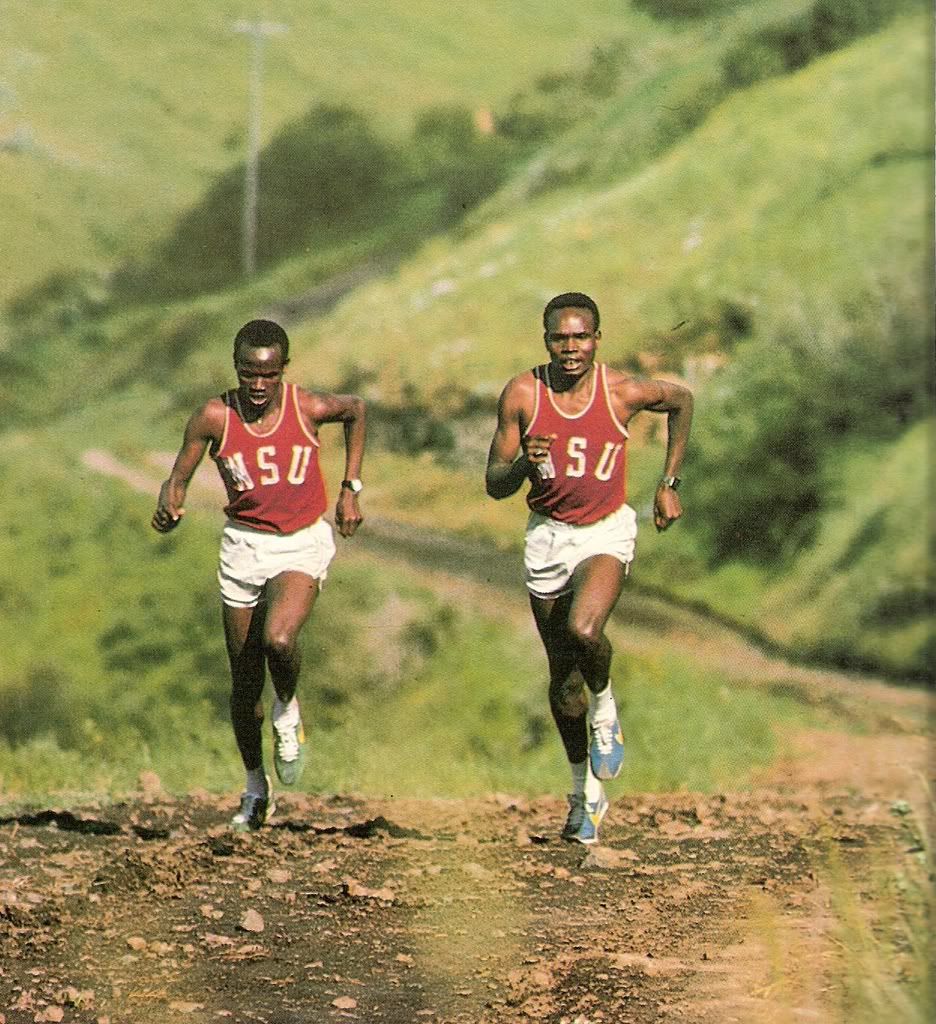
Henry Rono (r), training with college mate Samson Kimobwa
www.elatleta.com

      Kenya athletics had had to overcome a similar crisis the previous decade.  Its boycott to Montreal-76 and Moscow-80 deprived a whole generation of the chance of chasing their dream in the Olympic Games.  Athletics were languishing in Kenya and in words of John Manners “US College scholarships helped keep track from dying altogether in Kenya” (2)  Fred Hardy from Richmond had pioneered since the sixties, with Kip Keino’s collaboration, the initiative of bringing talented African runners to help American Universities shine in national championships. (3) All the young Kenyan promising runners as Samson Kimobwa, Henry Rono, Mike Musyoki, Sosthenes Bitok or Wilson Waigwa were there to develope their athletics career.  Grassroots work in their homeland had come to nothing and Kenyan athletics authorities were not doing either their ambassadors athletes life easy, owing their passports, trying to control every one of their moves, cashing every earning they had and causing them problems to compete in European meetings. Henry Rono, one of the most gifted distance runners ever, who achieved the unbelievable feat of smashing four world records (3000, 5000, 10.000 metres and steeplechase) in only 81 days, as a young Washington State collegian (4), ended precociously his career victim of alcoholism, altogether alienated.  He had become a moneymaker for agents, promoters and Kenyan authorities and his dream of competing for a medal in the Olympic Games was just unattainable.
      Kenya returned to a major global competition on the track for 1983 Helsinki World Championships.  Its results were not better than Ethiopians: a seventh placement in a final was its highest achievement.  No man was entered in the 10.000 metres event. At that point, African athletes seemed to have become mentally inferior to European or American ones.  Nevertheless, things improved in Los Angeles Olympic Games the following year. Among other high note performances, Julius Korir, brougth back to Kenya the steeplechase gold medal his predecessor in Washington State University, Henry Hono, was unable to fight for.  Anyway, results and image were still a world away from the ones at Mexico and Munich Olympic Games. 

         However, it was not at the track but at the Cross Country specialty that a radical change in approach was going to change the face of Kenyan athletics forever.  Two men, Mike Kosgei and John Ngugi were the responsible of this Kenyan revolution which shocked the athletics world and encouraged and inspired all future coaches and runners in the country. (2)
Initially, it was German Walter Abmayr who coached the national team and fostered Kenya’s entrance at 1981 World Championship.  The first results were not bad: two third and two fourth collective places.  In 1985 the IAAF started subsidizing poor countries.  This budget rise allowed Abmayr and his assistant Mike Kosgei a more complex system of regional trials, bringing to the national Championships, and a three weeks training camp at Nyeri.  This time Kenya finished a close second to Ethiopia and Paul Kipkoech grabbed the silver individual medal, after Carlos Lopes.

John Ngugi and Paul Kipkoech at 1987 Warsaw World Cross Champs.
Bob Martin /Getty Images/ All Sport

http://www.life.com/image/1233156

  After Abmayr’s depart, Kosgei took over and started to work his own way.  Firstly, he moved the camp to Embu, on the Eastern slopes of Mount Kenya, far away from friends, girlfriends and family who used to disturb the concentration in Nyeri. Secondly, he increased the number of workouts from 2 to 3 daily, including both high intensity and high mileage.  This killer preparation meant a radical rupture with tradition in Kenya.  A natural talent like Kip Keino could win an Olympic final with an almost casual training but it was not anymore possible in the eighties, with the huge science of sport advances and with every athlete being a full time professional.  Kosgei found a priceless ally in the rookie John Ngugi, who was also as ambitious as him and a hard-work fanatic.
       Ngugi, a Kikuyu, born in May 1962, who had migrated to the Nandi district as he was 3 years old, decided to join the Army forces in 1984, where he was employed as a mechanic. (5)  Soon he started to build up a solid reputation.  He used to wake up in the night and run for hours with the help of a torch.  Then he would went to sleep and in the morning would join the others for the scheduled training.  (2) Ngugi participated at Los Angeles Olympic Trials and the following year got his first international medal at the Easter and Central African Championships.  After winning both Army and National Championships, he was selected for the training camp in Embu.
      Mike Kosgei brutal workout regime did not seem enough to fit him, because he used to run on his own on a longer path, which was to be known as “the Ngugi route”. After his victory at the 1986 World Cross Champs, other athletes would join him the following year and, by 1988 he was leading the whole team on the “Ngugi route”.  The sensational results in successive championships would have the consequence of spreading the example everywhere in Kenya.  Now, every distance runner started trying Kosgei and Ngugi’s workout methods in order to become the next champion.
        More and more training camps were founded and the work at grassroots level was reinvigorated.  It really helped the newly launched IAAF World Junior Championships, which could serve as starting point for teen careers and at the same time as a showcase, where talents could be scouted by agents and international Universities.  Brother Colm O’Connell chose the first Kenyan team for the inaugural championships in 1986, held in Athens.  Despite saying he has just selected a dozen youngsters he new around, Kenya came back with nine medals.  Some of these teens like 5000 and 10.000 meters champion Peter Chumba would never start a professional career, while others like Wilfred Kirochi and Peter Rono would become celebrated stars.  These championships were also a starting point for African women athletes. Kenyan and Nigerian girls, won three and four medals respectively, the first ones they had collected in a global championship, in 1986, and Derartu Tulu, in the 1990 edition, with her gold medal at 10.000 metres would open the Ethiopian women road to success.
      O’Connell would also pioneer this incorporation of African female to the athletics circuit. The legendary coach, who had come from Ireland to St. Patrick School in Iten as a teacher of geography in 1976, did not have any knowledge of athletics when he started his sportive mission and learned everything from “watching the guys running”.  However his training camp has been for decades one of the most reputed Kenyan factory of champions, maybe because his intuitive teaching never tried to apply westerner contrasted training methods to African mentality. (6)

Lydia Cheromei wins the World Junior Cross Champs at the record age of 13
Gray Mortimore/ Getty Images/ All Sports


         Brother O’Connell first training camp was the Sing'ore summer High School for girls. In a society where the traditional female role is to get married and look out for the children and the house it was hard to assume they could follow a long term athletics career. The first Kenyan women in championships were just young girls, who were never thought to continue running once married.  Yet, O’Connell's protégée Susan Sirma, the first black African woman in winning a major track and field medal, a bronze in the 3000 metres at 1991 World Championships, just one year before Derartu Tulu’s gold medal at Barcelona Olympics, moved to Japan for athletics, far away from family and all the men who could control her life.  She was the admired role model for future star cousins Sally Barsosio and Lornah Kiplagat.  " We sang songs about her.  We would walk around her house.  When I would run after a goat, I would think "run like Susan".  Susan was like a really big thing." (7)  Brother O’Connell also mentored olympians Selina Chirchir, Hellen Kimaiyo and Lydia Cheromei. (8) The latter rose to fame, after winning the World Junior Cross Championships in 1991 at age 13!  After several dropouts and comebacks, Cheromei is still running competitively today as a marathoner.  Since 1991, East African women have only lost once in the senior World Cross Country and are unbeaten in the junior race, which was incorporated to the athletics calendar to their glory in 1989.
         Dedication and hard work were paying off, and Kenya proved to themselves and to the rest of the world they were ready to become the distance powerhouse in Track and Field, with their excellent performance at 1987 Rome World Championships and 1988 Seoul Olympic Games.  Paul Kipkoech started the Kenyan party in Rome in the 10.000 metres, playing his part as announced by coach Kip Keino: “We will take some risks and see what happens” (9).  Kipkoech came past the whole field, to run lap 5 in 60 seconds, then surged away again twice to unsettle the field and eventually went alone in lap 14, running the second half in an incredible 13:24 split, to win for more than 10 seconds.  Always second to Ngugi in Cross Country, he could show in Rome all his greatness.  Sadly, he fell soon victim of malaria and tuberculosis and died in 1995 at age 32.  
            Billy Konchellah also was plagued by several illnesses, all along his career, but in spite it could achieve two world championships victories in 1987 and 1991 in the 800 metres with his majestic and effortless stride.  Douglas Wakiihuri, who had gone on his own initiative to Tokyo to be coached by legendary Kiyoshi Nakamura, closed the games winning the third gold medal for his country in the marathon.  He would also get the silver the following year at the Olympic Games.
            Despite, being Kipkoech and Konchellah absents, Kenya increased its harvest to four golds in Seoul.  Paul Ereng ran as smoothly as Konchellah the 800 metres; Julius Kariuki continued the tradition in the steeplechase, romping home just one tenth of a second shy of Henry Rono’s world record; Peter Rono was the first of a long lineage of Brother Colm O’Connell pupils in winning an Olympic gold medal, in the 1500 metres distance; and finally, John Ngugi could translate his Cross Country hegemony to the track, in the 5000.  In Rome, the race had been too slow for him, and he had been passed by Said Aouita and almost everybody in the last lap.  Mike Kosgei, always a king of strategy, decided the most simple is what best fitted his trainee: “Just sprint throughout” (5).  Obedient, Ngugi surged in the third lap and never stopped, opening a gap nobody could close.  Amazingly, his tactics were not really different to what Romanian Paula Ivan had done in the 1500, after losing the 3000 race.
            Ngugi won his fourth Cross Country title in a row the following year in Stavanger, but injuries slowed him the two following years.  Kenya still kept the team title but Khalid Skah of Morocco won twice the single event, thanks to his powerful ending kick, over Moses Tanui.  Nevertheless, in 1992 the leader was back.  In Boston, the weather was as tough as you can imagine. The scenario seemed like a sign for a man who always had obtained his best triumphs in the hardest conditions. The Kenyans grouped in the front in a narrow point of the course and Ngugi went alone.  Skah never dared to follow him. With crops of snow floating in the air and covering everything, you still could distinguish his familiar long stride and his ferocious look.  It was the last big victory for a man whose contribution to the rising of Kenyan athletics can not be measured.   

Brother Colm O'Connell in his Athletics School in Iten
John Gichigi/ Getty Images
http://beijing2008.blogs.nytimes.com/2008/05/20/the-irish-priest-and-the-long-distance-runners-in-the-kenyan-highlands/